News
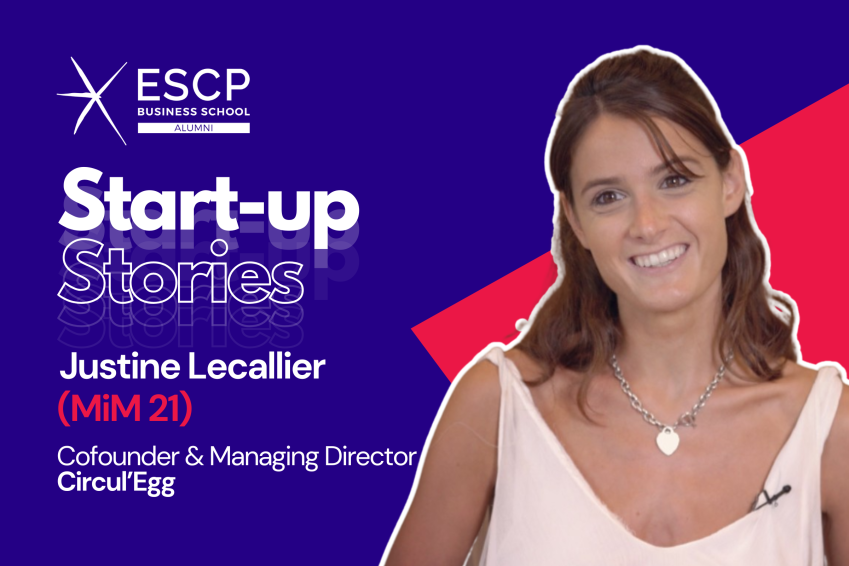
[Start-up Stories] Juliette Lecallier (MiM 21), Cofounder & Managing Director - Circul'Egg
In this new episode, Justine shares the key moments of her journey, what ESCP Business School (and especially the ESCP Blue Factory) brought her, as well as her advice for future entrepreneurs.
First, a short introduction of Cirul'Egg...
Circul’Egg, cofounded in 2020 by Justine Lecallier, Yacine Kabeche, and Samuel Olivier, transforms eggshells into sustainable ingredients. Using a patented mechanical process, the company recovers calcium and proteins from the membranes to create valuable products.
In 2023, Circul’Egg opened its first factory near Rennes, able of processing 15 to 20 tons of eggshells per day, with two production lines and an R&D lab, supported by a €5 million investment. This innovative approach reduces waste while promoting the circular economy.
👉 What made you want to become an entrepreneur? How did the idea for your start-up come about?
"I hadn’t planned on becoming an entrepreneur. I followed a traditional business school path, with a lot of involvement in associations focused on solidarity, animal welfare, biodiversity. The spark came during my final-year internship at an impact investment fund. I saw lots of committed projects and thought: “Why not me?”.
That’s when I met Yacine, my partner, through the NOISE Association at ESCP. He had this crazy idea: turning eggshells into a useful ingredient. The absurdity of the waste, the potential of the model, the AGEC law that had just been passed… everything aligned."
👉 How did your time at ESCP influence your entrepreneurial idea? An encounter, a course, an outstanding experience?
"ESCP was decisive. First, because that’s where I met my partner through NOISE. Then thanks to Maeva Tordo and the Blue Factory, who supported me a lot on very practical aspects like recruitment, team dynamics, and the first doubts when launching a company.
But above all, the ESCP Alumni network was a real booster. For our fundraising as well as the commercial side, it opened doors to large companies I would never have reached on my own. The school gave me structure, but most importantly, a strong community I can still rely on today."
👉 What were the highlights of your project's development?
"There are several, but four come to mind immediately:
- The day a major materials company said: “OK, we’ll test your solution.” You realize your project is becoming real.
- The opening of our first factory, in less than five years, starting from zero. It’s a huge turning point for an industrial startup.
- The first ton of eggshells collected. It was no longer an idea or prototype: it was tangible.
- And especially: the moment we brought the biggest players in the poultry sector to the table, to co-create a solution that works for them. We offered them a win-win model, with a real share of added value. That’s when we felt we could change the game together."
👉 Is there a key decision you would make differently?
"Yes, definitely: we should have outsourced certain operations earlier. We wanted to internalize everything from the start—to control quality, process, and impact—but that delayed our market entry. Today, I see that selling earlier, even in a “test” mode, would have helped us better understand customer needs from the beginning.
I also think it would have helped if all three co-founders had been in direct contact with clients from the start. Facing the field, sales, forces you to adjust your pitch, your product, your vision. It’s extremely educational."
👉 If you had to give just one piece of advice to future ESCP entrepreneurs, what would it be?
"Talk about your idea. As early as possible. Even if it’s not ready, even if it seems fragile. Talking about it allows it to mature, to create the first connections, and to find the right people to partner with or move forward.
And above all: dare to believe that you can create a profitable and impactful company. Impact isn’t just another marketing argument (or at least not only that); it’s a way to innovate, unite, and build something that lasts."